Best Golf Resort Stays in Ávila, Castile and León
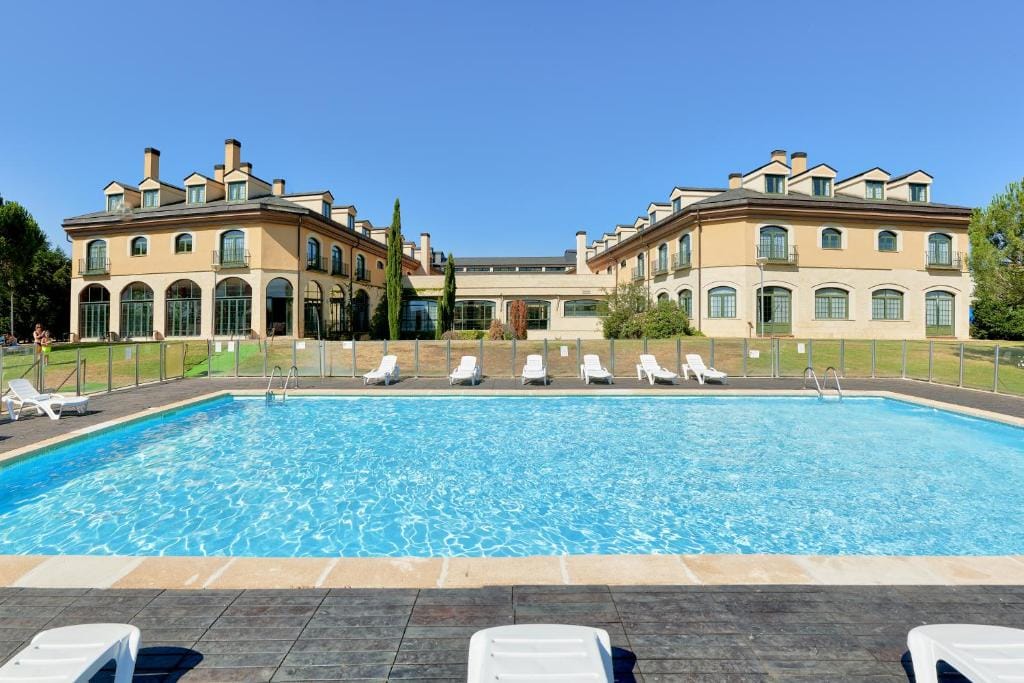
Golf resort stays in Ávila put a fairway within a short drive of the walled old town. Castile and León's provincial capital sits on a granite plateau at the foot of the Sierra de Gredos, higher than almost any other city in Spain, which keeps summer rounds noticeably cooler than the coastal circuits further south. The property carrying this tag pairs its own course access with the eleventh-century ramparts, the fortress-cathedral built into the wall itself, and the convent quarter tied to Santa Teresa de Ávila, all inside a few minutes' drive. Travelers who want a round of golf without giving up the medieval streets and the granite towers start here.
Golf Resort · Avila in numbers
Altitude, walls and a provincial table
Ávila's wall is the reason most travelers come, and it changes how a golf stay here plays out compared with a coastal resort trip. The old town is compact enough to walk end to end in under half an hour, so a stay built around a single golf property still leaves room for the Cathedral of the Saviour, whose apse forms part of the fortification itself, and the Basilica of San Vicente just outside the northeast gate. Guests based at the property tagged for golf can treat the course as the morning activity and the walls as the afternoon one, without the long coastal transfers that a Costa del Sol golf trip usually demands.
The altitude that makes Ávila the highest provincial capital in Spain is not a footnote for golfers, it is the whole pitch. Rounds that would be unplayable by midday heat on the Mediterranean coast in July and August stay comfortable here into the early afternoon, and evenings cool fast enough that a post-round dinner on a terrace rarely needs air conditioning. That same elevation and dry meseta air is why Ávila's winters run cold and its light stays sharp and clear for most of the year, a contrast locals mention before they mention anything else about their weather.
Santa Teresa de Ávila shaped the city's identity more than any other single figure, and her legacy still structures the old town's geography: the convent built on her birthplace, the route of the medieval streets she walked, and the citywide devotion around her that peaks every October during the city's saint's-day festivities. A golf stay here sits inside that same historic fabric rather than beside it, since the tagged property is close enough to the walls that the convent quarter, not a resort strip or a marina, is the natural walk after a round finishes and the clubs go back in the car.
Ávila's kitchen runs on what the high plateau and the Sierra de Gredos foothills produce, and it shows up on menus near the golf property as readily as inside the walls: chuletón de Ávila, the province's large cured veal chop, judías del Barco, the local white bean, and yemas de Santa Teresa, the candied egg-yolk sweets sold by nuns near the saint's convent. None of it is coastal resort food, and that is the point: a golf stay in Ávila trades beachfront buffets for a provincial table that has not been built around tourism.
Ávila earns its UNESCO listing on the strength of one continuous object: 2,500 metres of eleventh-century wall circling the old town, with eighty-eight towers still standing and gates that still funnel traffic the way they did for pilgrims and merchants. Santa Teresa de Ávila, the sixteenth-century mystic and reformer, was born inside those walls, and her convent and the streets around it remain the spine of the historic quarter. Outside the ramparts, the city sits on an open granite plateau in Castile and León, with the Sierra de Gredos rising to the south and a climate of sharp winters and dry, relatively cool summers that shapes everything from the food to the golf calendar.